Peptide Hubs GHRP-6
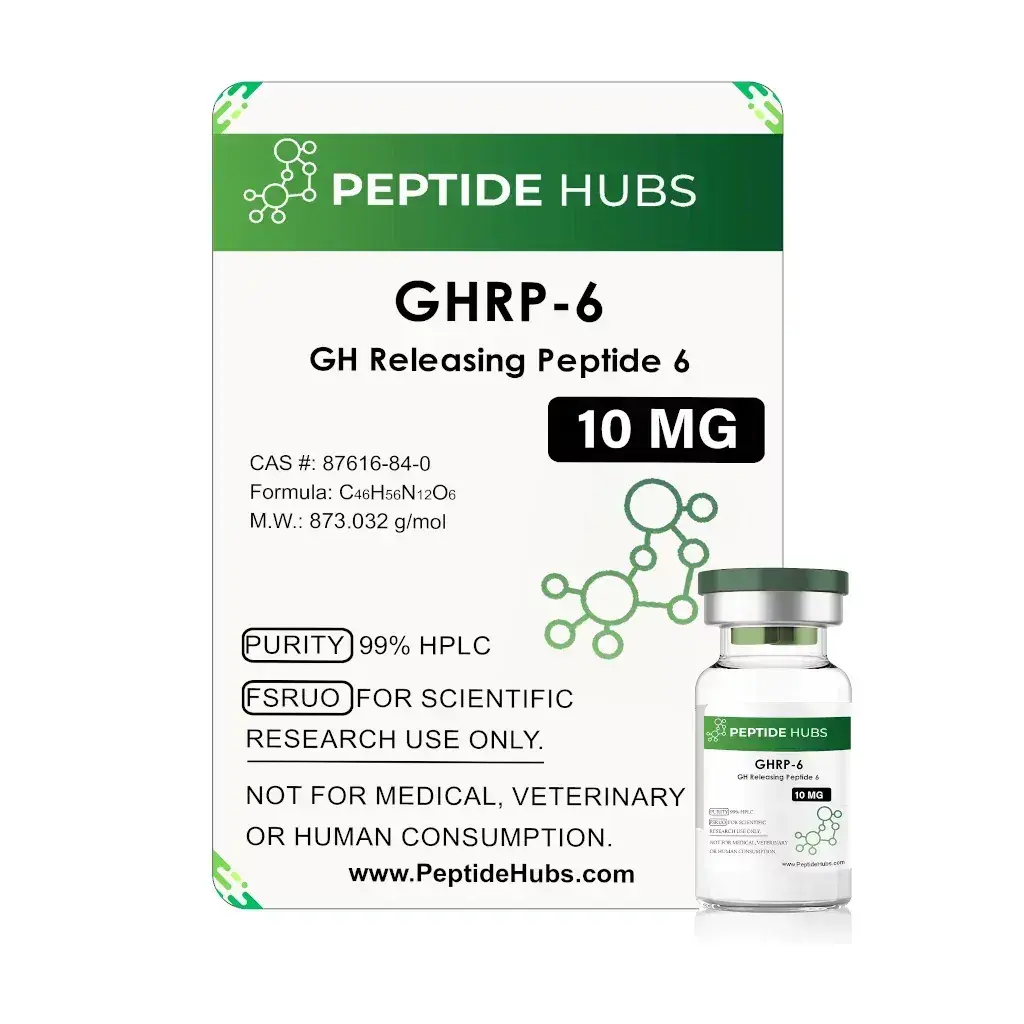
GHRP-6 (Growth Hormone Releasing Peptide-6) is a foundational and potent hexapeptide presented as a 10 mg lyophilized powder. As the first synthetic Growth Hormone Secretagogue (GHS) to gain widespread research attention, GHRP-6 is renowned for its dual-action mechanism: powerfully stimulating endogenous growth hormone (GH) secretion while inducing a profound increase in appetite. This high-dose 10 mg vial provides researchers with ample supply for extensive studies. For bodybuilders and athletes engaged in performance research, GHRP-6 offers a classic and robust model for investigating significant increases in anabolic hormone levels to support muscle growth and recovery, with its distinctive hunger effect making it a premier subject for studies focused on mass-gaining phases, metabolic regulation, and conditions of catabolic stress.
GHRP-6 Composition
Each sterile 2 mL vial contains 10 mg of synthetic GHRP-6 with the sequence: His-D-Trp-Ala-Trp-D-Phe-Lys-NH2. This hexapeptide features a D-amino acid at position 2 (Tryptophan) which helps confer resistance to enzymatic breakdown. The product is supplied as a pure, white lyophilized powder without fillers or preservatives, requiring reconstitution with bacteriostatic water before use in research protocols. Its straightforward structure has made it a benchmark in the study of ghrelin receptor agonists.
Bodybuilding and Athletic Research Benefits
In research models, GHRP-6 is valued for its potent and reliable effects on the somatotropic axis. Key investigational benefits include: strong stimulation of pulsatile growth hormone release, leading to elevated IGF-1 levels that promote protein synthesis and muscle hypertrophy; increased lipolysis (fat metabolism) contributing to improved body composition; accelerated recovery from training through GH-mediated repair processes; a powerful and rapid increase in appetite, which can be leveraged in research on bulking cycles, overcoming training plateaus due to caloric deficit, or studying cachexia; and potential positive effects on sleep quality and intestinal motility. For researchers, GHRP-6 provides a predictable and strong physiological response for studying GH dynamics and energy balance.
Therapeutic and Research Indication
While a research chemical, GHRP-6 and related secretagogues have been studied for growth hormone deficiency, wasting syndromes (cachexia), and gastrointestinal motility disorders. It acts as a ghrelin receptor (GHS-R1a) agonist, mimicking the action of the endogenous hunger hormone ghrelin. This binding triggers GH release from the pituitary and stimulates appetite centers in the brain. The foundational science of GHRPs is well-established, with resources from the National Institutes of Health (NIH) detailing their discovery and mechanisms.
Mechanism of Action: Ghrelin Mimicry and GH Release
GHRP-6 works by binding to and activating the Growth Hormone Secretagogue Receptor type 1a (GHS-R1a), the same receptor targeted by the natural hormone ghrelin. This activation initiates the inositol phosphate (IP3) signaling cascade within pituitary somatotroph cells, leading to calcium mobilization and the exocytosis of pre-synthesized growth hormone. Unlike GHRH, which works through cAMP, GHRP-6 provides a potent, complementary trigger for release. Additionally, it crosses the blood-brain barrier to act on hypothalamic neurons, stimulating the release of neuropeptide Y (NPY) and agouti-related protein (AgRP), which are potent stimulators of appetite. This dual-site action is central to its research profile.
Dosage for Research (Men)
Research protocols for GHRP-6 utilize microgram dosing multiple times daily. Common investigative doses range from 100 mcg to 300 mcg per administration, administered via subcutaneous injection. A standard research approach involves 2-3 daily doses: upon waking in a fasted state, post-workout, and approximately 30-60 minutes before bedtime to synergize with the natural nocturnal GH surge. When combined with a GHRH analog like CJC-1295 No DAC, doses are often matched. Research cycles typically span 8-16 weeks, with attention paid to potential desensitization with prolonged use.
Dosage for Research (Women)
Research dosing for female subjects generally follows the same microgram range, often starting at the lower end (e.g., 100 mcg per dose) due to potentially heightened sensitivity. The appetite-stimulating effect can be particularly pronounced and should be a key variable in study design and dietary tracking. As with all peptides, careful, observation-based protocol design is paramount.
Active Life and Half-Life
GHRP-6 has a plasma half-life of approximately 15-30 minutes, shorter than its successor GHRP-2 due to its less modified structure. The resulting GH pulse, however, elevates growth hormone levels for about 90-120 minutes. This pharmacokinetic profile necessitates a research dosing schedule of 2-3 times per day to create multiple, discrete GH pulses that mimic a youthful secretory pattern and maintain its effects on appetite.
GHRP-6 Side Effects
The most characteristic research observations are directly mechanism-driven: intense hunger peaking 20-40 minutes after injection, and transient flushing, warmth, or mild headache associated with the GH pulse. Compared to newer GHRPs, GHRP-6 has a greater tendency to cause moderate increases in cortisol and prolactin levels, which is an important consideration in endocrine research designs. Injection site reactions are possible. The profound hunger is GHRP-6's signature effect and a primary focus of many research studies.
Contraindications and Precautionary Measures
GHRP-6 is contraindicated in research involving subjects with active or suspected malignancies, due to the growth-promoting nature of GH/IGF-1. Caution is advised in studies with diabetic subjects or those with insulin resistance. Its potent effect on cortisol and prolactin necessitates careful monitoring in relevant research protocols. The significant appetite increase may be undesirable in fat-loss-focused studies. It is not for use in subjects with known hypersensitivity. GHRP-6 is strictly for controlled laboratory research.
Overdosage in Research
Exceeding standard research doses can lead to an amplification of its side effects: severe hunger, pronounced flushing, headache, nausea, and potentially more significant elevations in cortisol and prolactin. Chronic, extreme overdosage could theoretically contribute to symptoms of acromegaly. The peptide's short half-life limits the duration of a single overdosage event. Adherence to the established 100-300 mcg dosing range is critical for safe and interpretable research outcomes.
GHRP-6 Stack/Cycle for Research
GHRP-6 is powerfully researched in synergistic combination with GHRH analogs and can be part of broader performance stacks:
- CJC-1295 No DAC - The foundational stack for maximum GH release, combining GHRP-6's potent trigger with CJC's amplification of pulse size.
- GHRP-2 for direct comparative studies on potency, hunger stimulation, and hormonal side effects (cortisol/prolactin) between first and second-generation GHRPs.
- Ipamorelin as a comparator in research on selective vs. non-selective GHRP activity, contrasting hunger and hormonal profiles.
- Melanotan 2 in studies exploring combined effects on appetite, fat metabolism, and potential synergies in weight management or mass-gaining research.
- Tesamorelin to research a different approach to GH axis stimulation, comparing a GHRP+GHRH stack to a pure GHRH analog with specific visceral fat effects.
These combinations enable detailed research into manipulating the GH/IGF-1 axis for various physiological outcomes.
Package Presentation
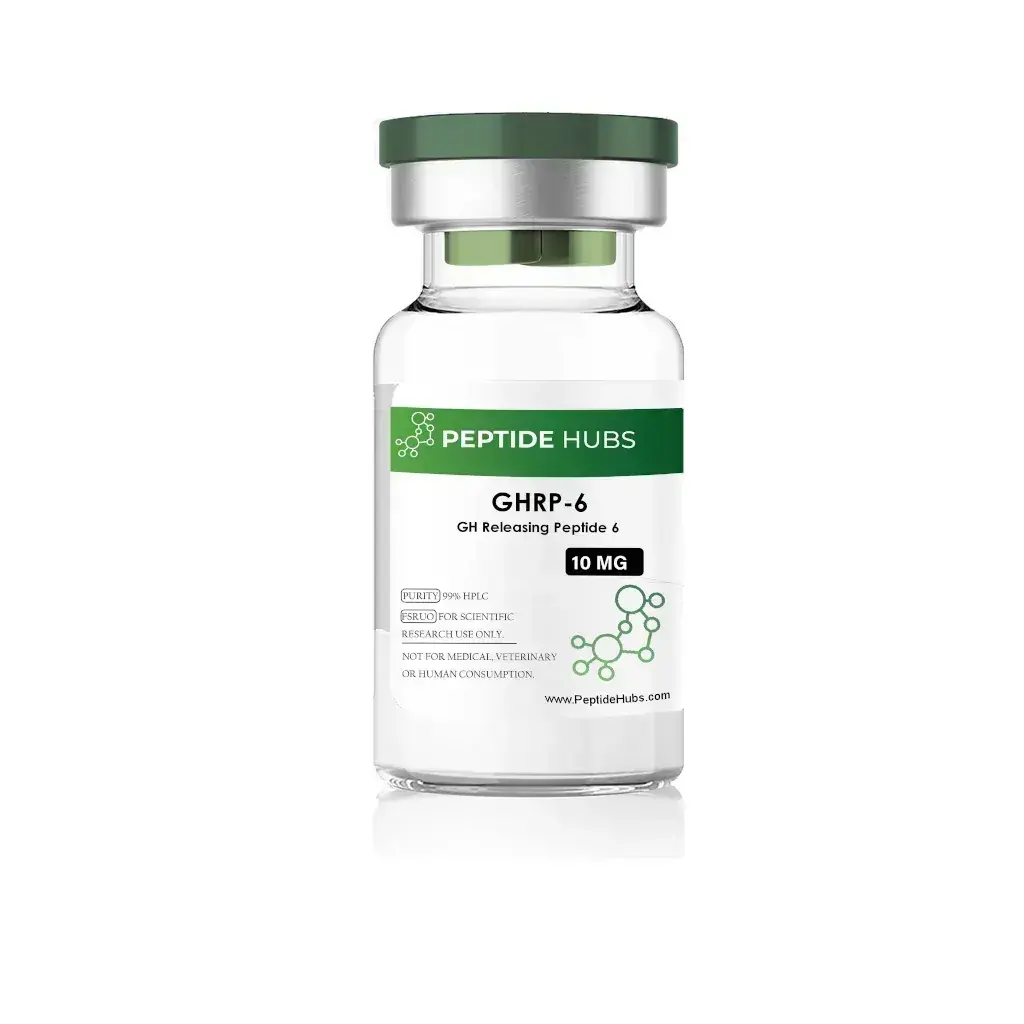
The product is supplied as one sterile glass vial containing 10 mg of GHRP-6 as a white lyophilized powder. The vial is sealed with a rubber stopper and an aluminum crimp cap to ensure sterility. The 10 mg size offers extended supply for research cycles. Packaging is discreet and secure.
Storage
For long-term stability, store the lyophilized powder at or below -20°C (-4°F). For short-term use during an active research cycle, refrigeration at 2-8°C (36-46°F) is sufficient. After reconstitution with bacteriostatic water, the solution must be refrigerated and used within 7-10 days to maintain peptide potency and prevent bacterial growth.
GHRP-6 Referrers
GHRP-6 holds a historic place in peptide science as the prototype synthetic Growth Hormone Secretagogue. Its discovery and characterization are documented in seminal endocrinology papers from the late 20th century. Researchers are encouraged to review this foundational literature to understand the context from which newer GHRPs (like GHRP-2, Ipamorelin, Hexarelin) were developed, and to appreciate GHRP-6's unique profile of potent GH release coupled with strong multi-hormonal and appetitive effects.