Peptide Hubs AOD 9604
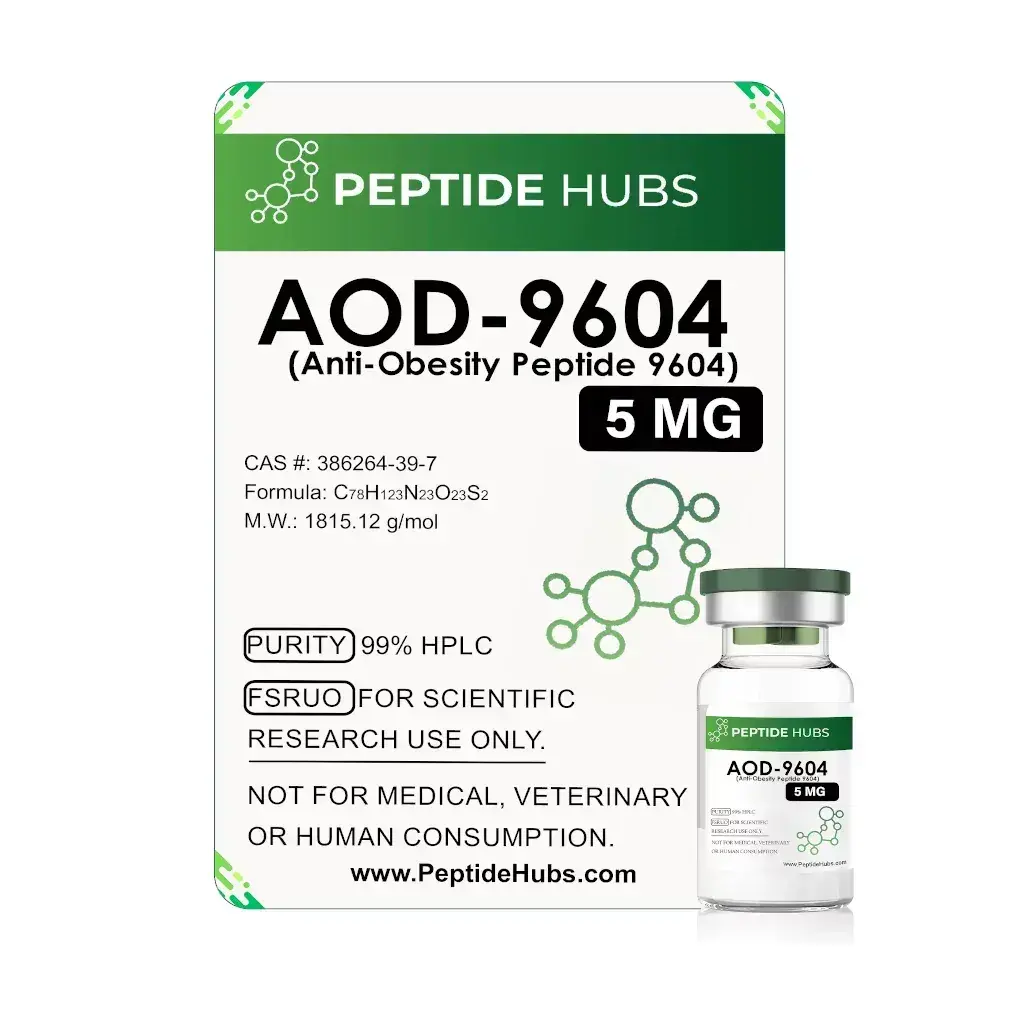
Peptide Hubs presents AOD 9604 (Advanced Obesity Drug 9604), a 5 mg vial of high-purity lyophilized powder designed for research into metabolic regulation and tissue repair. This synthetic peptide fragment (177-191) of human growth hormone (HGH) has been modified to retain the fat-burning properties of HGH without its growth-promoting or blood sugar-elevating effects. For bodybuilders, athletes, and fitness researchers, AOD 9604 represents a compelling compound for investigating enhanced fat loss, improved metabolic rate, and potential cartilage repair during cutting phases or injury recovery protocols.
AOD 9604 Composition
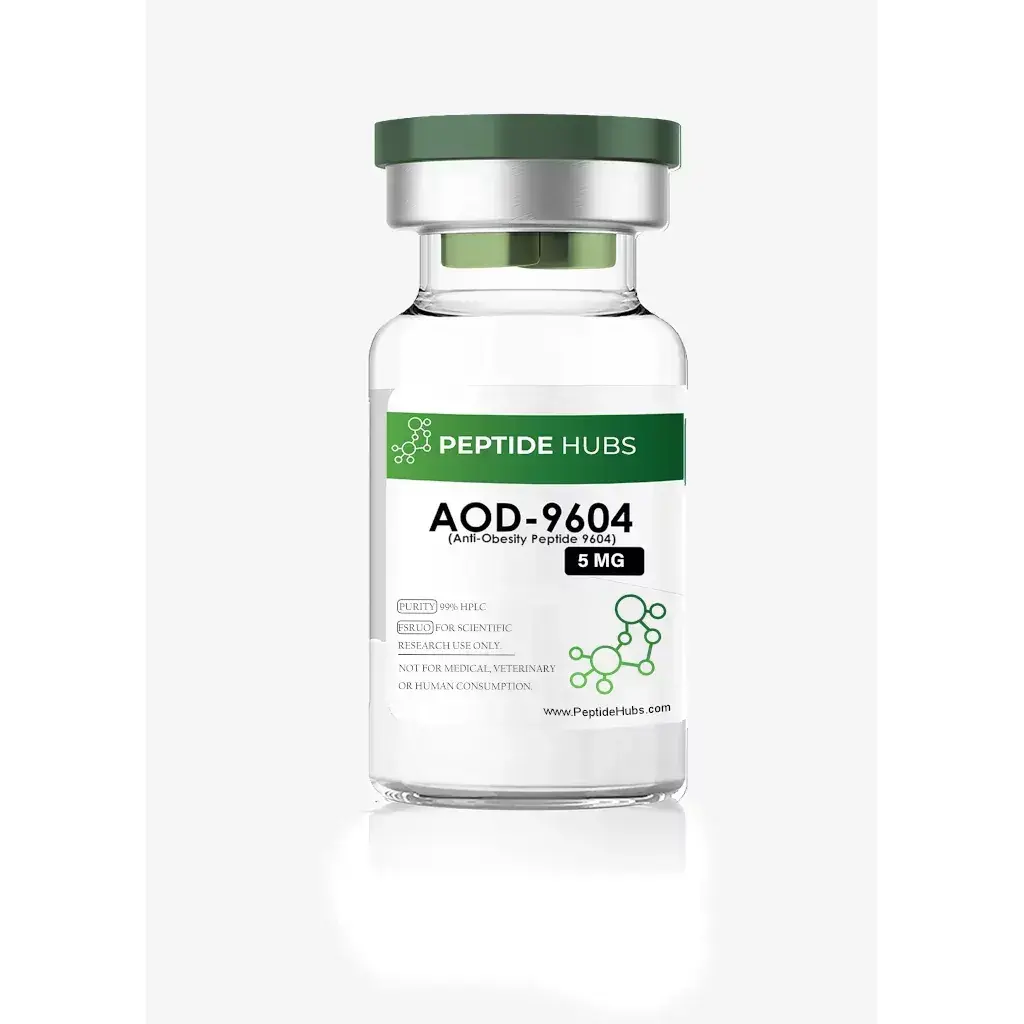
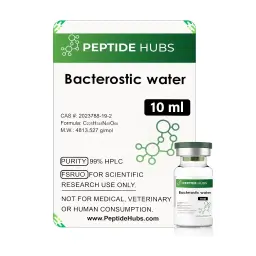
Each sterile 2 mL vial contains 5 mg of AOD 9604 as a white, lyophilized powder. The peptide sequence is Tyr-hGH (177-191), a modified fragment with a tyrosine substitution for increased stability and bioavailability. The product is free from additives or preservatives and requires reconstitution with bacteriostatic water before use in a research setting. This formulation ensures researchers work with a consistent and potent compound.
Bodybuilding and Athletic Research Benefits
In research models, AOD 9604 has demonstrated significant potential for body composition improvement. Its primary investigational benefits for athletes include promoting lipolysis (fat breakdown) while inhibiting lipogenesis (fat creation), similar to natural growth hormone but without systemic IGF-1 elevation. Researchers are interested in its ability to target stubborn fat deposits, particularly abdominal and visceral fat. Additionally, studies suggest it may stimulate chondrocyte growth, implying potential for supporting joint and cartilage health—a valuable area of research for heavy lifters and athletes.
Therapeutic and Research Indication
While classified as a research chemical, AOD 9604 has been studied in clinical contexts for obesity and cartilage repair. Its mechanism involves mimicking the way natural growth hormone signals fat cells to break down triglycerides. Unlike full-length HGH, it does not bind strongly to growth hormone receptors in muscle or bone. Authoritative sources, including a study referenced by the National Institutes of Health (NIH), have explored its metabolic effects
Mechanism of Action
AOD 9604 works by binding to the beta-3 adrenergic receptor and a novel, distinct fat cell receptor. This binding triggers a cascade that increases enzyme activity (hormone-sensitive lipase) responsible for breaking down stored fat into free fatty acids for energy. Simultaneously, it appears to block the action of the enzyme (acetyl-CoA carboxylase) that converts carbohydrates into fat. This dual-action mechanism makes it a unique subject for metabolic research.
Dosage for Research (Men)
Research protocols for AOD 9604 vary. In human trials for obesity, doses of 300-500 mcg per day have been studied. For athletic research into fat loss and recovery, common investigative doses range from 250 mcg to 500 mcg, administered via subcutaneous injection once or twice daily. It is often researched in cycles of 4-12 weeks. As with all research peptides, starting at the lower end of the dosage range is critical to assess tolerance in the specific research model.
Dosage for Research (Women)
Research dosing for female subjects generally follows similar microgram-per-day protocols as for men, often starting at the lower threshold (e.g., 250 mcg daily). Due to physiological differences in fat distribution and hormone sensitivity, careful observation is necessary. Some research suggests women may respond favorably to similar dosing schedules, but conservative protocol design is always recommended.
Active Life and Half-Life
AOD 9604 has a relatively short half-life, estimated at approximately 30 minutes in circulation. However, its metabolic effects on fat cells are longer-lasting, influencing processes over several hours. For sustained research effects, daily administration is typical. Its rapid clearance is considered an advantage, minimizing long-term systemic exposure.
AOD 9604 Side Effects
Research indicates AOD 9604 is generally well-tolerated with a favorable safety profile in studies. Reported effects in trials are mild and can include temporary redness or itching at the injection site. Unlike full HGH, it has not been associated with significant water retention, joint pain, or insulin resistance in research settings. Its targeted mechanism minimizes off-target effects.
Contraindications and Precautionary Measures
AOD 9604 is contraindicated in research involving subjects with known hypersensitivity to any of its components. While it doesn't significantly affect blood sugar, researchers monitoring subjects with metabolic conditions should proceed with caution. It is for research use only in laboratory settings and not for human consumption, diagnosis, or treatment.
Overdosage in Research
There is limited data on extreme overdosage. Exceeding research-level doses significantly may theoretically lead to increased local irritation or amplify its pharmacological effects without added benefit. In a research context, adherence to established microgram dosing protocols is essential to maintain the integrity of the study and subject safety.
AOD 9604 Stack/Cycle for Research
AOD 9604 is versatile in research stacks, particularly for cutting and recovery studies. It combines well with other peptides that have complementary mechanisms:
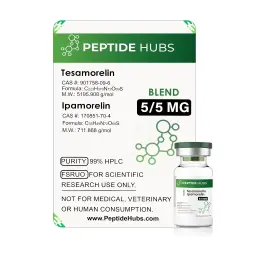
- Tesamorelin/Ipamorelin to potentially amplify natural GH pulse and fat loss synergistically.
- TB 500 for a comprehensive research approach to injury healing and connective tissue repair.
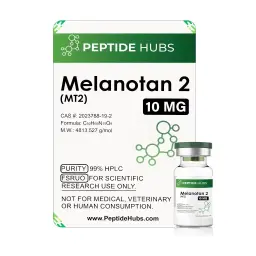
- Melanotan 2 to investigate combined effects on fat metabolism and appetite modulation.
- GHK-Cu for research into skin quality, systemic healing, and anti-inflammatory effects alongside fat reduction.
- Sermorelin as a potential GHRH analog to support the body's own GH production in a different pathway.
These are research concepts for experimental design only, not consumption advice.
Package Presentation
The product is supplied as one sterile glass vial containing 5 mg of AOD 9604 as a white lyophilized powder. The vial is sealed with a rubber stopper and aluminum cap to ensure sterility and is shipped in discreet, secure packaging.
Storage
For maximum stability, store the lyophilized powder in a freezer at or below -20°C (-4°F). For short-term storage, a refrigerated environment at 2-8°C (36-46°F) is acceptable. After reconstitution, the peptide solution must be refrigerated and used within a short timeframe according to sterile research practices to prevent degradation or contamination.
AOD 9604 Referrers
The scientific basis for AOD 9604 is documented in peer-reviewed literature. Key references include clinical trials on its effects on body fat, such as those cataloged by the NIH, and in-vitro studies on its chondrogenic potential. Researchers are encouraged to review this primary literature to design robust and informed study protocols.